
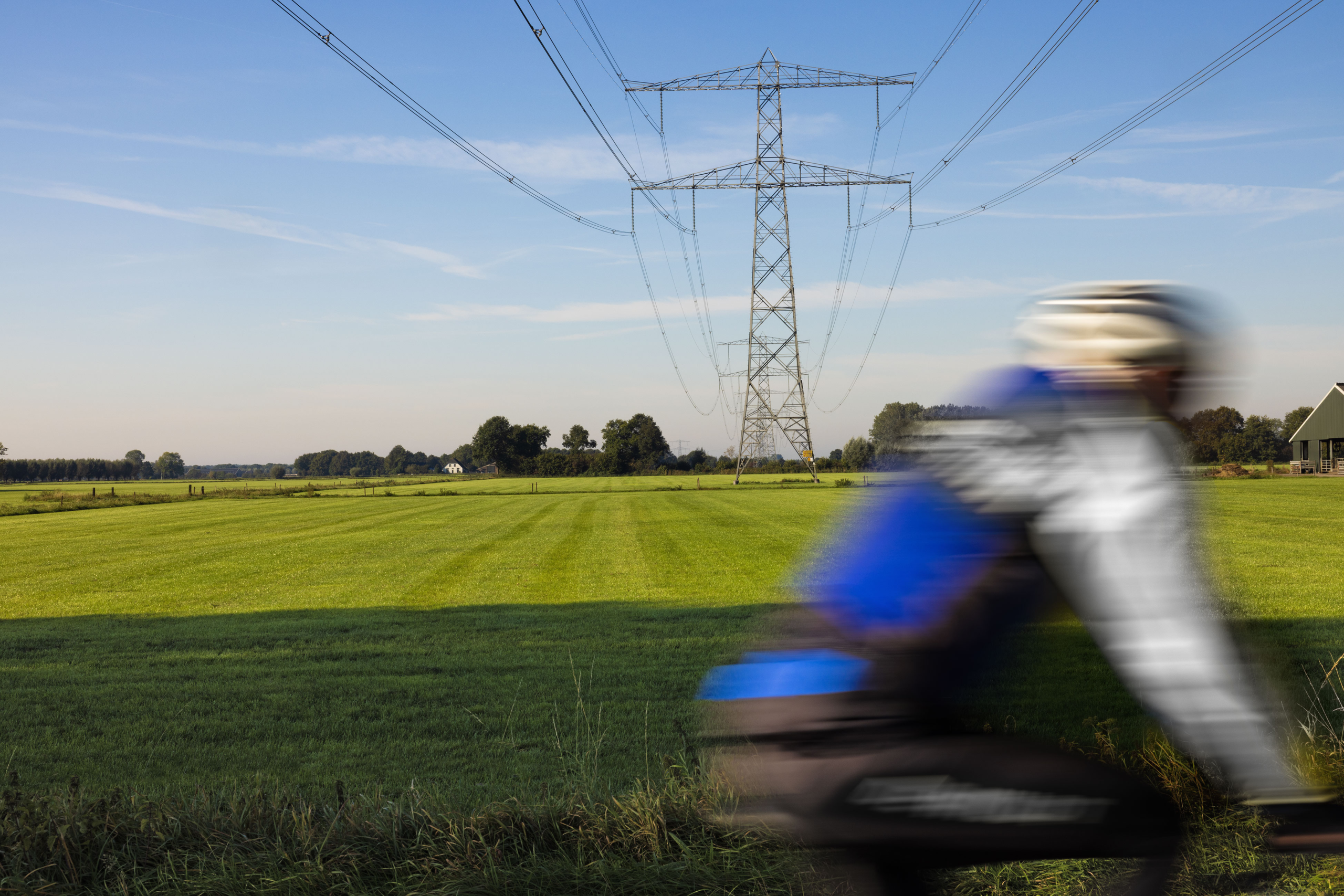
What TenneT’s 2025 Annual Report Tells Us About the Dutch High-Voltage Grid: the Backbone on Which Our Digital Economy Rests.
Beneath our digital and industrial prosperity lies the Dutch high-voltage grid: a national infrastructure already running at its limits, while the true peak of the energy transition is yet to come. That tension is largely invisible: the strain beneath the high-voltage pylons, where billion-euro investments, permitting delays, grid congestion, cyber threats and talent shortages converge in a single indispensable infrastructure. From that perspective, TenneT becomes more than a grid operator: it is the backbone on which the Netherlands is building its future competitiveness – precisely where the strain beneath the high-voltage pylons is now unfolding at a rapid pace.
I write this piece in a personal capacity, as a reflection on TenneT’s 2025 Annual Report and the Wennink Report (December 2025).
Summary: TenneT Annual Report
March 2026, TenneT published its 2025 annual report. TenneT faces a decade of unprecedented pressure: 5 billion euros in annual investment, 60% of projects running an average of 2.5 years behind schedule, and the complexity of the grid exploding as a result of the energy transition. At the same time, the Wennink Report warns that the Netherlands can only thrive if four preconditions are met, including affordable clean energy and robust digital infrastructure. That places TenneT squarely at the heart of the national competitiveness agenda.
Yet the grid is not ready for the digital and physical demands of tomorrow: mission-critical IT risks falling behind, cyber threats are escalating, and strategic decisions on cloud policy, AI integration and IT/OT convergence are now being forced, with enormous consequences for the decade ahead.
1. The Strain Beneath the High-Voltage Pylons
On 28 April 2025, the lights went out for sixty million people in Spain and Portugal. Not due to an attack, not due to a storm. A cascade of voltage problems in the grid caused generators to trip automatically, and a domino effect paralysed two countries within minutes. TenneT explicitly cites this incident in its annual report as a wake-up call for European grid operators: the systems we built for a stable fossil-fuel-based electricity system were not designed for the volatility of wind and solar.
In that same year, TenneT invested €5 billion in the Dutch high-voltage grid. That is a historic record. And yet 60% of planned expansion projects ran an average of 2.5 years behind schedule. Around 713 grid connection requests remain open. Large industrial parties, data centres, battery storage facilities, and wind farms are all in the queue. The grid is clogging up while society waits. All figures in this piece are drawn from TenneT’s 2025 Annual Report, published yesterday.
This is not a temporary organisational problem. It is a structural tension between what society demands of network infrastructure and what the system, technically, digitally and politically, can deliver. It is precisely at this intersection that IT specialists and energy professionals face the toughest choices of their careers in the decade ahead.
2. TenneT by the Numbers: Impressive and Alarming
What is going well
TenneT operates over 11,500 kilometres of high-voltage connections, serves more than 18 million end users, and posted an underlying EBIT of €992 million in 2025 (2024: €625 million). The onshore availability rate stood at 99.99977%: a near-perfect performance. All 700MW offshore wind connection programmes were delivered on time and within budget. ROIC rose to 6.7%.
What is alarming
Investment fell €1.1 billion short of target (€4.97bn vs. €6.06bn goal). The reason: the forced termination of the contract with offshore contractor Petrofac, which went bankrupt, delayed five critical 2GW offshore platforms. Wennink argues that the Netherlands must achieve at least 1.5 to 2 percent annual economic growth, and that is only possible if energy remains affordable and clean: the precondition TenneT is currently failing to meet. The connection backlog is exploding. There are currently around 1,000 expansion projects in the portfolio. TenneT’s reputation score fell from 7.8 (2022) to 7.4 (2025).
The question is not whether TenneT has a problem, but to what extent it can scale up its various projects and programmes quickly and in a controlled manner to keep pace with rising growth in both supply and demand.
3. The Wennink Lens: Energy as an Economic Precondition
Former ASML chief executive Peter Wennink, who delivered a report The Road to Future Prosperity: A Strong Netherlands in a Relevant Europe, commissioned by the Dutch government, similar to the Draghi Report for Europe. He identified four preconditions for Dutch competitiveness: 1) simplification of regulations, 2) a focus on talent and excellence, 3) clean and affordable energy, and 4) investment in infrastructure and ecosystems.
Energy features explicitly as the second precondition. Not as a nice-to-have, but as a licence to operate for the entire economy. Wennink argues that additional investment of between 151 and 187 billion euros will be needed by 2035, stressing that heavily energy-dependent industries may relocate abroad if energy costs cannot be kept under control.
This is the bridge to TenneT. Every day the grid is congested, every month a data centre or factory cannot be connected, is a day the Dutch economy loses ground. As ASML chief executive, Wennink already argued forcefully that the energy transition is only possible through further electrification of society, and that this in turn is only possible with chips and the semiconductor sector. Yet those chips themselves require enormous amounts of electricity and stable grid infrastructure.
The circle is complete. Without a stable, expanded and digitally managed grid, there is no ASML, no AI gigafactory, no hydrogen economy. TenneT is the foundation on which the Wennink plan rests. And that foundation is showing cracks.
4. Mission-Critical IT in a Changing Grid: The Hidden Vulnerability
This is the part of the debate that receives too little attention. Everyone talks about cables, pylons and permitting procedures. But the real vulnerability over the coming decade lies in IT/OT convergence, the merging of information technology and operational technology, and the fundamental question of whether TenneT’s digital backbone is ready for the transition.
What TenneT itself reports
The annual report is remarkably candid on this subject. TenneT is preparing to implement new EMS/SCADA systems for both onshore and offshore operations in 2026. Phasor Measurement Units (PMUs), a new Wide Area Monitoring System (WAMS), a dynamic security system for voltage and frequency stability (DSA), and machine learning for forecasting models are all on the way. This is the Control Room of the Future (CROF) programme.
At the same time, the IT, OT & Cybersecurity risk category features prominently in the Risk Universe. TenneT acknowledges: “Increased use of digital technologies, IT/OT integration and complex and extensive supply chains introduce new cybersecurity risks.”
The critical tension
TenneT maintains an explicit policy that is simultaneously prudent and restrictive: no cloud deployment for mission-critical systems or applications. This is stated verbatim in the risk appetite table under “Low risk appetite”, alongside zero tolerance for cyber threats above an extremely low level.
On one hand, this is understandable. Critical infrastructure must not depend on hyperscalers operating from American or Asian data centres, subject to different jurisdictions and potentially vulnerable to geopolitical pressure. NIS2, the CER Directive and the new Dutch Energy Act (in force from 1 January 2026) place stringent demands on the sovereignty and availability of systems.
On the other hand, this means TenneT must make major investments in on-premise or private cloud infrastructure at a time when the capabilities of public cloud platforms in AI, real-time processing and resilience are far ahead of what can be achieved internally. The question is not whether TenneT needs to manage the Dutch grid using AI-assisted operations, that is unavoidable, but how to do so without crossing the sovereignty boundary. What is certain is that a well-executed IT/OT convergence strategy is not merely a security exercise: it is also a data strategy. Integrating operational technology with modern IT systems unlocks a continuous stream of high-resolution grid data that is currently locked inside ageing SCADA systems and field devices. More and better OT data means sharper forecasting, faster fault detection, and the granular real-time visibility that advanced grid management demands.
The Digital Twin as a strategic asset
TenneT is investing in digital twins through the National Facility Digital Twin of the Electricity System (NFDTES) in partnership with TU Delft. This is strategically sound: a digital twin enables grid scenarios to be simulated, maintenance to be optimised and new connections to be planned without physical testing. But a digital twin is only as good as the data that goes into it. And this is where the chain becomes visible: the NFDTES digital twin is entirely dependent on the availability of high-quality OT data from the field. That data, in turn, depends directly on the SCADA modernisation being delivered through the Control Room of the Future programme. Without a completed, reliable and integrated SCADA infrastructure feeding live operational data into the twin, the model remains a simulation of yesterday’s grid rather than a mirror of today’s. The digital twin and the Control Room of the Future are therefore not two separate investments: they are two ends of the same data pipeline.
5. The Five Strategic Bottlenecks for the Decade Ahead
Based on the annual report and the Wennink vision, I identify five bottlenecks that will be decisive for TenneT over the coming decade, and for everyone who depends on or works with the Dutch electricity infrastructure.
Bottleneck 1: The permitting mill: structural, not incidental
60% of projects run 2.5 years behind schedule. TenneT’s own Investment Plan 2026-2040 encompasses around 1,000 projects. The delays are structurally embedded in spatial planning processes, nitrogen legislation, appeal procedures and local resistance.
TenneT and the Ministry of Climate and Green Growth have agreed on an Acceleration Package intended to cut lead times by 50%. This is ambitious, but requires the cooperation of dozens of municipalities, provinces, and courts. The Council of State ruling on the Rilland-Tilburg connection (380 kV, 80 km, expected completion 2031-2034) illustrates how long this takes even when everything goes smoothly.
Discussion question: Should the Netherlands establish a separate legal procedure for critical energy infrastructure, comparable to the Route Decision for motorways, in which national security interests outweigh local objections? Or would this be undemocratic in a country that holds participation in high regard?
Bottleneck 2: Supplier dependency: a geopolitical time bomb
The Petrofac crisis is not an isolated incident; it is a symptom. TenneT’s offshore 2GW programme depends on a handful of specialised suppliers: Hitachi Energy for HVDC converters, specific cable manufacturers, Siemens, and ABB for switchgear. When a single supplier fails, it leads directly to project delays of two years or more.
Moreover, the semiconductors essential for modern protection relays, SCADA systems, and digital meters are concentrated in production at TSMC (Taiwan) and Samsung (South Korea). Wennink, in his time as ASML chief executive, emphasised that all major transitions, climate, energy, and digitalisation, depend on chips, and that this dependency represents a strategic risk for Europe.
Discussion question: Should the Netherlands (or Europe) build up strategic reserves of critical components for energy infrastructure, comparable to strategic oil reserves? And who pays for it: the grid operator, the government or the end user through their power bill?
Bottleneck 3: IT/OT convergence: the gap between ambition and reality
TenneT’s operational technology, including SCADA systems, protection relays, and balancing platforms, is in part decades old. The new EMS/SCADA systems will be implemented in 2026. But IT replacement in critical infrastructure is not a standard migration: every moment of downtime or instability during the transition is a potential security risk.
At the same time, the complexity of the system being managed is growing exponentially. In the past, TenneT managed a relatively predictable system of a small number of large, dispatchable power plants. Today it manages hundreds of thousands of variable sources: wind turbines, solar panels, batteries, EV Charging hubs and industrial flexibility contracts (TDTR, GOPACS). The volume of data that must be processed in real time to keep the grid in balance is unprecedented.
Discussion question: May a TSO such as TenneT, which manages public infrastructure, rely on systems it does not fully control itself for mission-critical AI-assisted decisions? And how does this relate to the NIS2 obligation for risk management in critical infrastructure?
Bottleneck 4: Affordability versus investment needs: the political fault lines
Annual grid costs for an average household rose to €130 in 2025 (2024: €126). This seems modest, but growth in the investment base will lead to substantially higher grid tariffs in the years ahead. TenneT’s investments are heading towards more than €6 billion per year, financed through state-guaranteed loans up to a ceiling of €52 billion.
The political risk is real. As energy bills rise, public pressure to slow the pace of expansion grows. TenneT acknowledges this itself: “Political support for grid expansion is increasingly tied to affordability concerns.” In a country where the Wennink Report calls for 150 billion euros in investment, yet where the political composition of the government changes regularly, this is a structural risk.
Discussion question: Should the financing of critical grid infrastructure run entirely through regulatory tariffs, or is there a role for direct government subsidy, comparable to the way defence, education or public health are funded? And how do you prevent the energy transition from becoming a financial burden for lower-income households?
Bottleneck 5: Talent scarcity: the forgotten bottleneck
TenneT has 4,823 employees and 890 external staff, and hired 746 new employees in 2025. An additional 5,000 technicians are needed across the sector by 2030, and TenneT is working with other grid operators, contractors, and vocational colleges through the Scale-Up Plan 2030.
From an IT perspective, there is a particular challenge: the hybrid profile of the OT security specialist. Someone who masters both the world of industrial control systems (Modbus, DNP3, IEC 61850) and modern cybersecurity frameworks (NIS2, ISO 27001, Zero Trust) is rarer than gold. TenneT needs these people now, not in five years.
Discussion question: Is the sector-wide approach to talent recruitment (Scale-Up Plan 2030) realistic, or is there a need for a national energy transition corps, comparable to how defence or NS strategically recruits and trains personnel? And what role should universities and colleges play?
6. What Can You Expect from TenneT Over the Next 10 Years? An Honest Assessment
What will go well:
- The offshore expansion will be realised, but later than planned. By 2034, TenneT will likely reach 20 GW of offshore capacity, albeit two to four years behind the original schedule.
- The digital transformation of the controlroom-ecosystem (CROF, EMS/SCADA, Digital Twin) has been set in motion and is irreversible.
- The financing is solid. The state guarantee of €52 billion and the cost-based regulatory model give TenneT the financial headroom to continue the investment agenda.
- European cooperation (OTC, InterOPERA, TSO Innovation Alliance) offers prospects for shared standards and efficiency gains in HVDC technology.
What will remain a problem:
- Permitting and spatial planning will remain the critical bottleneck. No technological or financial instrument can resolve this without political will at all levels of government.
- IT/OT convergence and cybersecurity are existential risks that are still insufficiently addressed at the level of architectural decisions.
- Supplier concentration will remain a geopolitical risk. The energy transition is making Europe more dependent on Asian production capacity for components, while geopolitical tensions are rising.
- Affordability will become increasingly politically sensitive as energy bills rise and the majority of the population does not directly benefit from the investments.
7. Conclusions: Food for Debate
Proposition 1: TenneT has become too big to fail. That is itself a risk
The Dutch state guarantees up to €52 billion in debt. TenneT is so systemically critical that no government can allow it to fail. But scale itself is a risk. Research into agile project management and large-scale programme delivery consistently shows that the larger the project, the greater the probability of failure: cost overruns multiply, coordination complexity grows non-linearly, and the consequences of misjudgement become harder to absorb. TenneT’s portfolio of roughly 1,000 concurrent projects, many interdependent, sits squarely in the danger zone that project management literature identifies as the threshold beyond which traditional governance models routinely break down. The state guarantee provides financial security, but it does not reduce programme risk. If anything, it may reduce the urgency to confront it.
Proposition 2: The “no cloud for mission-critical systems” policy is unsustainable in the longer term
The gap between the digital capabilities of hyperscalers (Microsoft Azure, AWS, Google Cloud) and what TenneT can build and maintain internally will only widen. AI-driven grid management, real-time balancing of millions of flexible sources, and cybersecurity detection at scale: these are services the industry delivers via the cloud, not via on-premise systems. The question is not whether TenneT will use cloud services for operational support, but when and under what sovereignty guarantees. And that raises an equally pressing question: will European sovereign cloud providers, such as Gaia-X initiatives or national alternatives (OVHcloud, Hetzner, Scaleway, STACKIT), be ready in time? TenneT’s demand for sovereign, secure, and high-performance data storage and compute is not incremental. Managing a 20 GW offshore grid with near real-time AI balancing will generate data volumes and latency requirements that only hyperscale infrastructure can meet. If European sovereign cloud cannot match that scale and reliability within the next five to seven years, TenneT will face a binary choice: accept dependency on non-European hyperscalers, or accept a digitally under-powered grid.
Proposition 3: The Netherlands needs a National Energy Governance Council
The current model, in which TenneT operates under regulation by the ACM, acts on mandates from multiple ministries and seeks alignment with around 8 regional grid operators, hundreds of municipalities, and provinces, is too fragmented for the scale of the challenge. Wennink proposed a Government Commissioner for Future Prosperity. For the energy sector specifically, an even stronger coordination mechanism may be needed: a National Energy Governance Council with genuine decision-making authority.
Proposition 4: The real test for TenneT will not come from external factors, but from the internal control room
The next major outage in the Netherlands will probably not result from a hurricane or an attack, but from a combination of: a cyber attack on an ageing OT system, compounded by unexpected peak demand during a heatwave. System vulnerability is not linear but exponential when risk factors converge. TenneT knows this. The question is whether investments in resilience are moving fast enough.
This article was written through the dual lens of IT expertise and energy systems knowledge, based on TenneT TSO B.V. Annual Report 2025, the report “The Path to Future Prosperity” by Peter Wennink (December 2025), and publicly available sources. I am not claiming to know everything about the energy system, and this is my own personal interpretation. This article has deliberately been formulated in this way to stimulate debate, focus attention on major topics, and start a discussion.
Discover more from Pragmatic Technology Thinking
Subscribe to get the latest posts sent to your email.


